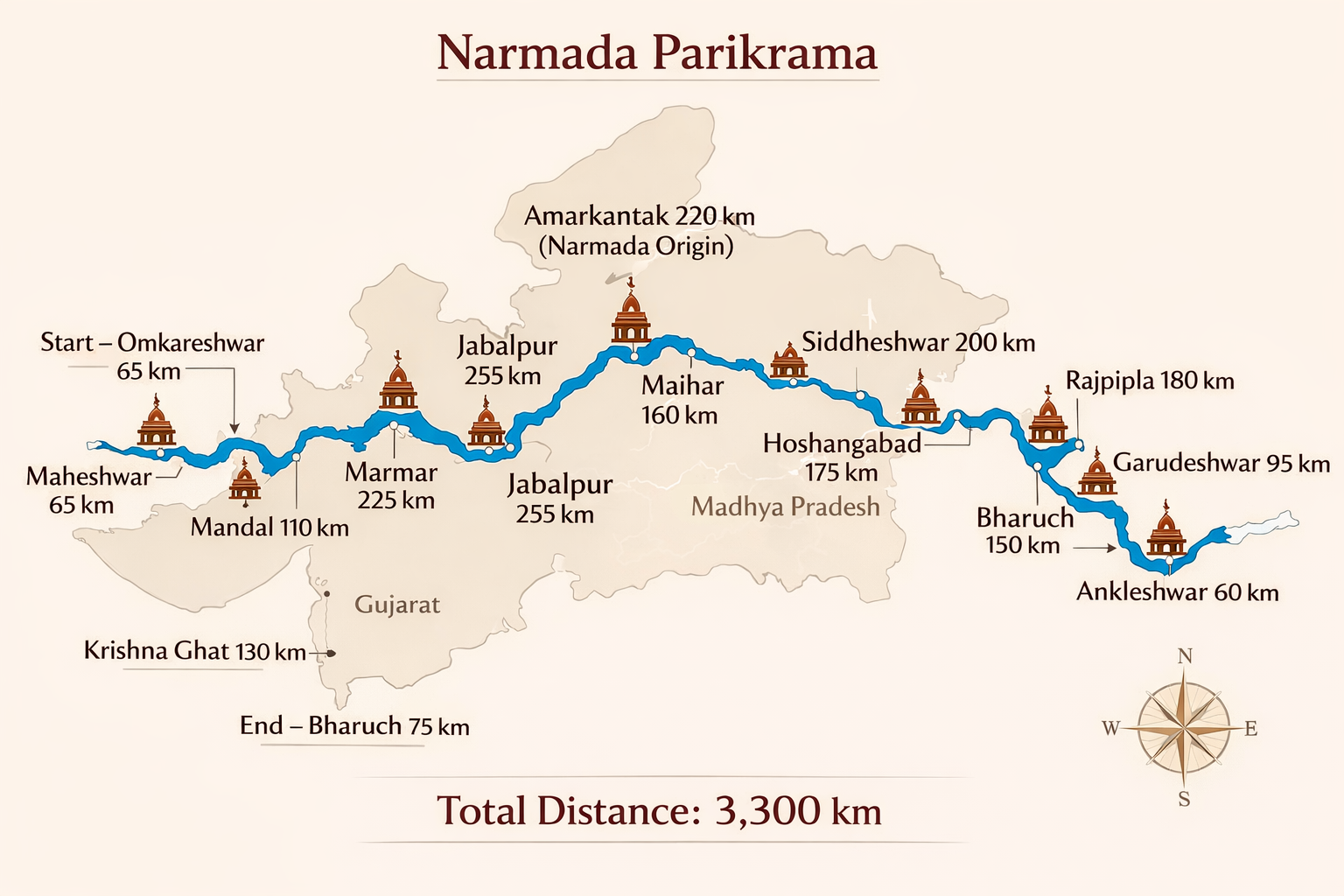
Understanding the complete Narmada Parikrama route and distance is the most critical preparation step for pilgrims embarking on this sacred 3,000-kilometer circumambulation of the holy Narmada River.
Embarking on the sacred Narmada Parikrama is one of the most spiritually enriching pilgrimages in India. Devotees undertake this divine journey by circumambulating holy Mother Narmada, walking strictly along both her banks from the river’s sacred origin at Amarkantak in Madhya Pradesh to the Arabian Sea confluence at Bharuch in Gujarat, and returning on the opposite bank without ever crossing the river water.
Comprehensive overview of the sacred Narmada Parikrama circuit across MP, Maharashtra, and Gujarat.
Narmada Parikrama Route and Distance Breakdown
The total Narmada Parikrama route and distance spans approximately 2,600 to 3,200 kilometers, depending on the specific route taken, river bank diversions, and detours to tributary ashrams. The overall duration is determined by your chosen mode of transport:
| Travel Mode |
Approx. Total Distance |
Estimated Duration |
Daily Travel Target |
| Foot (Traditional Padayatra) |
2,600 – 3,200 KM |
3 to 6 Months |
18 – 25 km/day |
| Private Vehicle (Car / SUV) |
3,000 – 3,500 KM |
15 to 25 Days |
100 – 160 km/day |
| Organized Bus / Tour Package |
3,200 – 3,600 KM |
14 to 21 Days |
Fixed Itinerary |
For pilgrims planning to travel by motor vehicle, check our detailed Narmada Parikrama by Car 30-Day Route Plan for daily halt recommendations and driving waypoints.
Detailed Narmada Parikrama Route Overview
The traditional pilgrimage adheres strictly to a clockwise circumambulation (Pradakshina). This separates the journey into two distinct legs along the river banks:
1. The Southern Bank (Dakshin Tat / Downstream Journey)
Pilgrims traditionally begin their journey at Amarkantak, the holy birthplace of Maa Narmada, keeping the river on their right shoulder while traveling westward toward the sea:
- Amarkantak to Jabalpur (approx. 240 km): Moving through Dindori and Gorakhpur to reach Gwarighat, Tilwaraghat, and the famous marble cliffs of Bhedaghat.
- Jabalpur to Hoshangabad (approx. 260 km): Traversing Narsinghpur, Barman Ghat, and Babai before arriving at Sethani Ghat in Narmadapuram (Hoshangabad).
- Hoshangabad to Omkareshwar (approx. 180 km): Continuing through Handia to the sacred island of Omkareshwar Jyotirlinga, a prime starting and finishing milestone.
- Omkareshwar to Bharuch Estuary (approx. 380 km): Journeying through Mandleshwar, Maheshwar, Barwani, Rajpipla, and Netrang to reach the holy sea confluence at Vimleshwar.
2. The Sea Mouth Crossing (Vimleshwar to Mithi Talai)
A sacred rule dictates that pilgrims must never cross the Narmada River directly. The only scripturally authorized crossing takes place where the Narmada empties into the Arabian Sea. Devotees board authorized motorized pilgrim boats at Vimleshwar (South Bank) and cross the ocean estuary to Mithi Talai (North Bank), completing the southward descent without crossing river waters.
3. The Northern Bank (Uttar Tat / Return Journey)
After reaching Mithi Talai, pilgrims begin the eastward return along the northern shore:
- Bharuch to Kevadia / Garudeshwar (approx. 110 km): Visiting Shuklatirth, Nareshwar, and the sacred samadhi of Shri Vasudevanand Saraswati Swami Maharaj at Garudeshwar.
- Garudeshwar to Nemawar (approx. 340 km): Passing through Tilakwada, Kukshi, Dharampuri, and Maheshwar North bank toward Nemawar (Siddheshwar Mahadev), the holy geographical navel (Nabhi Sthan) of the river.
- Nemawar to Amarkantak (approx. 490 km): Returning east via Kareli, Tendukheda, Shahpura, Mandla, and Dindori, finally climbing back to Amarkantak to conclude the circle.
Key Pilgrimage Points on the Narmada Parikrama Route
When mapping your Narmada Parikrama route and distance checkpoints, ensure your itinerary includes these historic spiritual centers and ashrams:
- Amarkantak (Anuppur, MP): The source at Narmada Udgam Temple, Mai ki Bagiya, and Kapildhara Falls.
- Bhedaghat & Chausath Yogini (Jabalpur, MP): Spectacular marble rock gorge and Dhuandhar waterfall.
- Barman Ghat (Narsinghpur, MP): Confluence of the Narmada and Varahi rivers with deep spiritual roots.
- Omkareshwar & Mamleshwar: One of the 12 sacred Jyotirlingas situated on the Mandhata river island.
- Maheshwar (Khargone, MP): The historic capital of Rajmata Ahilyabai Holkar, famous for its stone ghat architecture.
- Siddhanath Temple (Nemawar, MP): Revered as the exact central point between the source and the sea.
- Garudeshwar & Chandod (Gujarat): Major pit-stops for Pitru Tarpan rituals and spiritual solitude.
For an itemized list of verified dharamshalas, read our complete Sacred Places and Ashrams Directory. Pilgrims can also cross-reference government accommodation and heritage resthouses via Madhya Pradesh Tourism.
Essential Rules and Travel Tips for Pilgrims
Completing this demanding route requires physical preparedness, cultural respect, and spiritual dedication:
- The Clockwise Rule (Pradakshina): Always keep the river to your right side. Never swim across to the opposite bank mid-journey.
- Carry the Holy Water (Kalash): Fill a copper container with Narmada water at your starting shrine and carry it along the entire perimeter for the closing abhishek.
- Best Season to Travel: The optimal window to undertake the journey is between October and March. Monsoon months (June to September) cause dangerous river flooding, while peak summer (April to June) brings severe heat waves across central India.
- Astrological Muhurat: Traditional pilgrims consult their Vedic horoscope to begin during an auspicious planetary phase. Calculate your favorable timing using our Free Janma Kundali Online Calculator.
- Packing Essentials: Carry government photo IDs, basic electrolyte powders, personal medications, sturdy footwear, a power bank, and a compact headlamp for early morning walking.
Narmada Parikrama Route and Distance FAQs
What is the exact total distance of Narmada Parikrama?
The total distance spans between 2,600 km and 3,200 km on foot. If traveling by car or bus, road detours and ghat access roads usually extend the distance to approximately 3,000 to 3,500 km.
Where can I start the Narmada Parikrama?
While Amarkantak is the traditional starting point, pilgrims can formally begin at any sacred ghat along the river (such as Omkareshwar, Gwarighat in Jabalpur, or Nemawar), provided they finish their full circle at that exact same ghat.
How many days are required for a vehicle parikrama?
A vehicle parikrama by private car or tour bus comfortably takes between 15 and 25 days with planned daily stops of 100 to 150 km.
Looking for a complete step-by-step master plan? Read our comprehensive Narmada Parikrama Guide 2026 covering comprehensive route maps, rules, and packing lists.